Two years ago, "using AI in software development" meant autocomplete that finished your for loop. Today it can mean something much bigger: describing a feature in plain English and watching a working implementation appear. That second mode has a name now — vibecoding — and it's worth being precise about how it differs from AI-assisted development, because the two require very different habits, and very different amounts of trust.
AI-assisted development: the AI as a fast pair
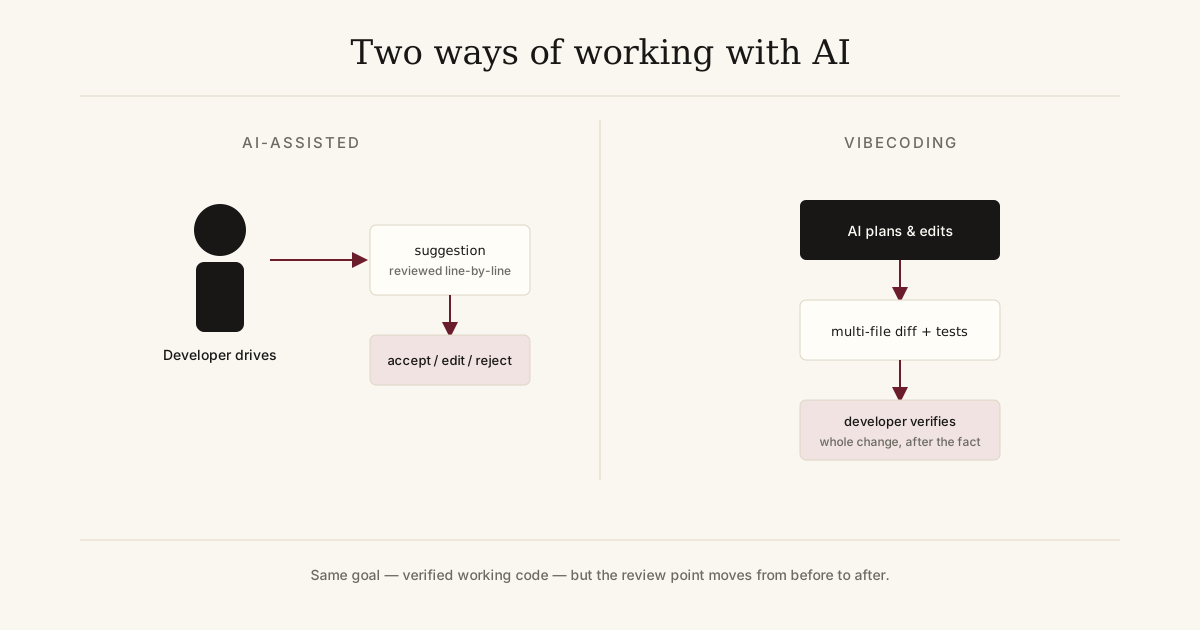
This is the mode most engineers already live in. You're driving. The AI suggests a function signature, writes a regex you'd rather not write by hand, explains an unfamiliar error, or refactors a block you select. Every suggestion lands in front of a developer who already understands the codebase, and who reads, edits, and accepts or rejects it before it ships.
- You hold the architecture in your head; the AI fills in the syntax.
- Review happens before the code is committed, line by line.
- The AI is a force multiplier on tasks you could already do — just faster.
Vibecoding: the AI as the driver
Vibecoding flips the relationship. You describe an outcome — "add a dark mode toggle that remembers the user's preference" — and the AI plans, edits multiple files, runs the tests, and iterates on failures largely on its own. Your job shifts from writing code to directing and verifying it: reading diffs, running the app, deciding whether the result actually does what you wanted.
The skill that matters most in vibecoding isn't typing speed — it's knowing what "correct" looks like well enough to recognize when the output isn't, even if it compiles and the tests are green.
Where the risk actually lives
The danger in vibecoding isn't that the AI writes bad code — modern models write pretty reasonable code most of the time. The danger is scale without a reviewer. A human pair programmer who writes one bad line gets caught by the other person almost immediately. An AI agent that writes 400 lines across six files, all internally consistent and all subtly wrong about one business rule, can sail through "looks fine, tests pass" if nobody reads it closely.
That's why, on this site's own backend, every AI-driven change still goes through the same gate: run the test suite, run the linter, and — for anything user-facing — actually click through it in a browser before calling it done. Vibecoding doesn't remove that step. If anything, it makes it more important, because the volume of generated code per minute went up.
A practical comparison
| Aspect | AI-assisted | Vibecoding |
|---|---|---|
| Who writes the code | You, with suggestions | The AI, end to end |
| Review point | Before each line lands | After a whole change lands |
| Best for | Familiar codebases, precise edits | Prototypes, scaffolding, well-tested domains |
| Main risk | Slightly wrong suggestions, easy to catch | Confidently wrong large changes |
| Required skill | Writing code, faster | Reading, testing, and specifying code |
So which one should you use?
Honestly — both, depending on the stakes. For a quick internal script, a prototype, or scaffolding a new page, vibecoding gets you from idea to working draft in minutes, and the cost of being wrong is low. For anything touching production data, payments, authentication, or a system other people depend on, I still default to AI-assisted: smaller diffs, reviewed as they happen, with tests as the safety net.
The honest takeaway is that vibecoding doesn't replace engineering judgment — it just moves where that judgment is applied. You spend less time on syntax and more time on specification, verification, and knowing when to slow down. That trade is worth making for a lot of work. It is not worth making for all of it.